Aug 19, 2026 · Endura FRP Team
How to Choose the Right FRP Grating for Industrial Applications
Specifying FRP grating for an industrial project is not a catalog decision — it is a service-environment decision. The panel that fits a pedestrian walkway on a paper machine floor will not survive a chemical plant washdown pad. The vinyl ester that handles bleach plant splash is overkill (and overpriced) for a pedestrian bridge in a dry warehouse. And a heavy 50 mm moulded panel on a low-traffic walkway is money that should have gone into a better resin system somewhere else on the same project.
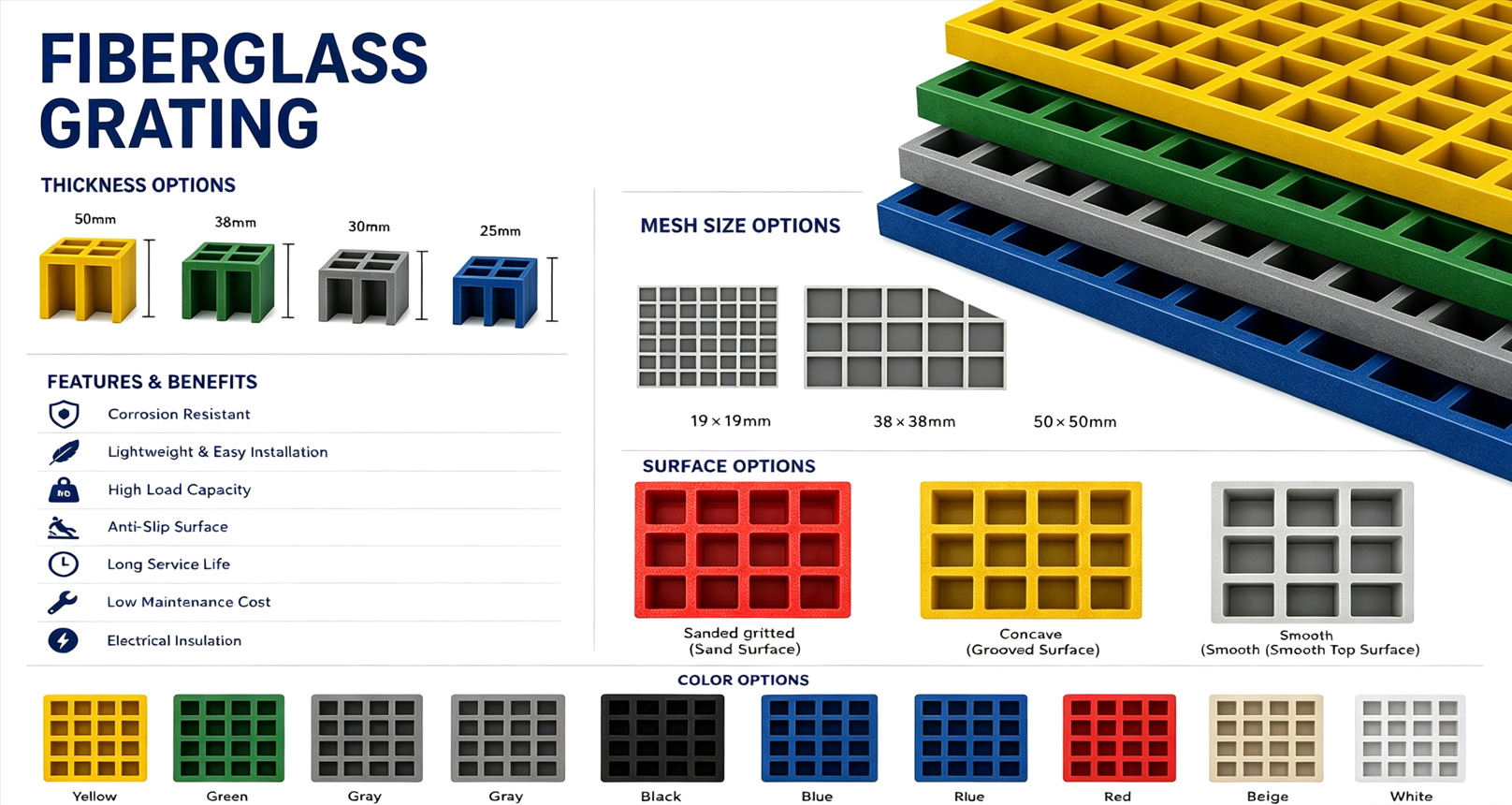
This guide works through the five questions an engineer should answer before a panel goes on the RFQ — environment, load, surface, resin, mesh — and ties each one to the panel sizes and resin grades we actually ship at Endura FRP (moulded 13 / 25 / 30 / 38 / 50 mm; pultruded I-type and T-type). Use it as a pre-issue checklist and the panel you receive will hold up across the full 20-year design life.
Why the spec, not the price, drives the lifecycle
The cheapest quotation is rarely the cheapest installation. A standard polyester panel in a bleach plant splash zone shows surface attack within 18 months. A 50 mm moulded panel on a pedestrian walkway is over-spec'd by 30%, and the budget you saved would have bought a vinyl ester upgrade in a more demanding zone.
The hidden cost of mis-spec is replacement. FRP grating is removable. The production line it sits over usually is not. An unplanned shutdown to replace a corroded walkway in a 316 stainless process plant can run six figures per day — and that's before counting the incident report and the audit finding that often follows.
Five factors drive every FRP grating spec. Get any one wrong and the panel fails before its design life.
1. Environment: chemistry, moisture, temperature
Start here. The environment dictates the resin, which is the single largest cost driver in the panel.
Chemical and process plants. Anywhere acids, alkalis, solvents, or bleach chemistry are present, specify vinyl ester resin. It is rated for continuous service across pH 1–13 in most formulations tested to ASTM C581, and is the standard for chemical plants, bleach plants, and any area where splash or vapour exposure is routine.
Wastewater and biological service. Constant moisture plus H₂S and biological attack from clarifier, digester, and headworks areas. Isophthalic polyester handles most municipal wastewater service. Vinyl ester for industrial wastewater with chemical loading above typical municipal strength.
Power and electrical areas. Dielectric strength matters more than chemical resistance. ASTM D149 ratings above 10 kV make FRP the safer choice over galvanized steel or aluminum for substation platforms, transformer decks, switchgear rooms, and battery rooms.
Outdoor exposure. UV stability comes from the resin formulation plus a UV-inhibited surface veil. Without that veil, expect surface chalking within 5–7 years of direct sunlight.
2. Load: pedestrian, equipment, vehicle
Match panel thickness to the load case before looking at anything else. The standard Endura FRP moulded FRP load table:
| Application | Panel | Typical span |
|---|---|---|
| Pedestrian walkway, light foot traffic | 25 mm moulded | up to ~600 mm |
| Pedestrian + occasional cart / pallet jack | 30 mm moulded | up to ~750 mm |
| Industrial platform, regular light-equipment traffic | 38 mm moulded | up to ~900 mm |
| Heavy equipment, vehicle traffic | 50 mm moulded | up to ~1200 mm |
Pultruded FRP (I-type and T-type) handles longer spans at equivalent thickness — typically 1.5× to 2× the moulded capability — because of the unidirectional glass architecture. Use pultruded where spans exceed what moulded can carry without intermediate supports.
For pedestrian-only service, 25 mm moulded with 19 mm mesh is the default. For vehicle or heavy-equipment service, 38 mm minimum, often 50 mm. Calculate deflection as well as ultimate load: 6 mm (¼") max deflection under design load is the conservative target.
3. Surface: concave, gritted, or solid top
The walking surface is a separate decision from the structural panel — and it is where most safety incidents actually happen.
Concave (smooth meniscus) surface. The standard meniscus profile moulded into the top of the panel. Provides modest slip resistance and is comfortable under light shoe or bare-foot traffic. Suitable for dry industrial service and indoor walkways where washdown is minimal.
Quartz-grit surface. A fused abrasive aggregate integrated into the top of the panel. Required anywhere wet, oily, or washdown conditions exist — food processing, chemical plants, offshore platforms, oil and gas, and any outdoor platform. Specify fine grit (20–40 mesh) for general industrial use; coarse grit (16–30 mesh) for heavy-oil or marine service where the coefficient of friction has to survive constant water and oil film.
Solid top / cover plate. A 3–12 mm plate bonded to the top of the grating for odour control, light spill, or pedestrian-only zones where small objects falling through the mesh would be a problem. Endura FRP produces bonded cover plates for trench covers and enclosed walkways.
Do not specify concave for washdown service. The meniscus fills with water or oil and the coefficient of friction drops sharply — slip incidents follow.
4. Resin: orthophthalic, isophthalic, vinyl ester, phenolic
Resin choice is the single biggest determinant of chemical and thermal performance.
- Orthophthalic polyester — general industrial service, mild chemical exposure, lowest cost. Use only where the environment is truly benign.
- Isophthalic polyester — the workhorse. Better chemical resistance than orthophthalic, handles most wastewater and mild chemical splash. The default for roughly 70% of Endura FRP shipments.
- Vinyl ester — the premium resin. Full chemical resistance spectrum, and the only correct choice for bleach plant, digester, or severe acid / alkali service. A 20–30% cost premium over isophthalic, but a small fraction of the replacement cost if the wrong resin is specified.
- Phenolic — for low-smoke, zero-halogen fire performance. Required in many transit, offshore, and enclosed electrical applications. ASTM E84 Class 1 flame spread with very low smoke developed.
Do not accept "vinyl ester" as a generic term — confirm the resin manufacturer's certification to ASTM C581 in the specific chemicals present in your service environment.
5. Mesh: 12, 19, 25, 38 mm
Mesh opening drives drainage, fall-through safety, and small-object loss prevention. The standard Endura FRP mesh sizes:
- 12 × 12 mm mesh — pedestrian safety, prevents tool drop, ~60% open area. Default for elevated walkways above work areas.
- 19 × 19 mm mesh — the most common industrial grating. Good balance of drainage (~65% open) and foot support.
- 25 × 25 mm mesh — heavy drainage, less comfortable to walk on, used in trench covers and process areas with high water flow.
- 38 × 38 mm mesh — maximum drainage, only suitable on thick panels (50 mm moulded) where foot support remains adequate.
Rule of thumb: smaller mesh for pedestrian and safety zones, larger mesh for drainage-heavy areas on thicker panels.
Common specification traps
After working through hundreds of RFQs across our installation base, three mistakes come up most often.
Specifying thickness without resin. A 50 mm moulded panel in orthophthalic polyester is the worst of both worlds — heavy and expensive, but not chemical-resistant. Always specify resin and thickness together.
Comparing panels with different open area. A 19 mm mesh moulded panel and a 25 mm mesh panel at the same thickness have very different load and drainage ratings. Normalize the comparison before you compare quotations.
Skipping the resin certificate. A resin certificate from the manufacturer (ASTM C581 testing in your specific service chemicals) is the only reliable evidence the panel will perform. Without it, the warranty is largely meaningless.
Pre-RFQ checklist
Before you send an FRP grating RFQ, confirm each line:
- Application environment (chemicals, moisture, UV, temperature)
- Load case (pedestrian, equipment, vehicle, span)
- Surface type (concave, fine grit, coarse grit, solid top)
- Resin grade (orthophthalic, isophthalic, vinyl ester, phenolic)
- Panel thickness (25 / 30 / 38 / 50 mm moulded, or pultruded I/T)
- Mesh size (12 / 19 / 25 / 38 mm)
- Panel size (standard 1220×3660 / 1220×4040 / 915×3050 mm; custom available on request)
- Edge treatment (open, banded, covered)
- Fixings (M-clip, saddle clip, J-clip — stainless grade for corrosive service)
- Resin certificate to ASTM C581 in the service chemicals
- Fire rating (ASTM E84 class, if required)
- Sample panel for approval before production run
If you can fill in every line, the panel you receive will do the job. If you cannot, that is the conversation to have with your FRP grating supplier before placing the order.
How Endura FRP supports specification
Endura FRP ships moulded and pultruded FRP grating in standard panel sizes from 1220×2440 mm up to 1220×4040 mm, and in all four resin grades above. Our specification team reviews RFQs against this checklist and returns a panel spec, layout drawing, and resin certificate within one business day for standard configurations. Send your RFQ to our sales team and we will work through it together.