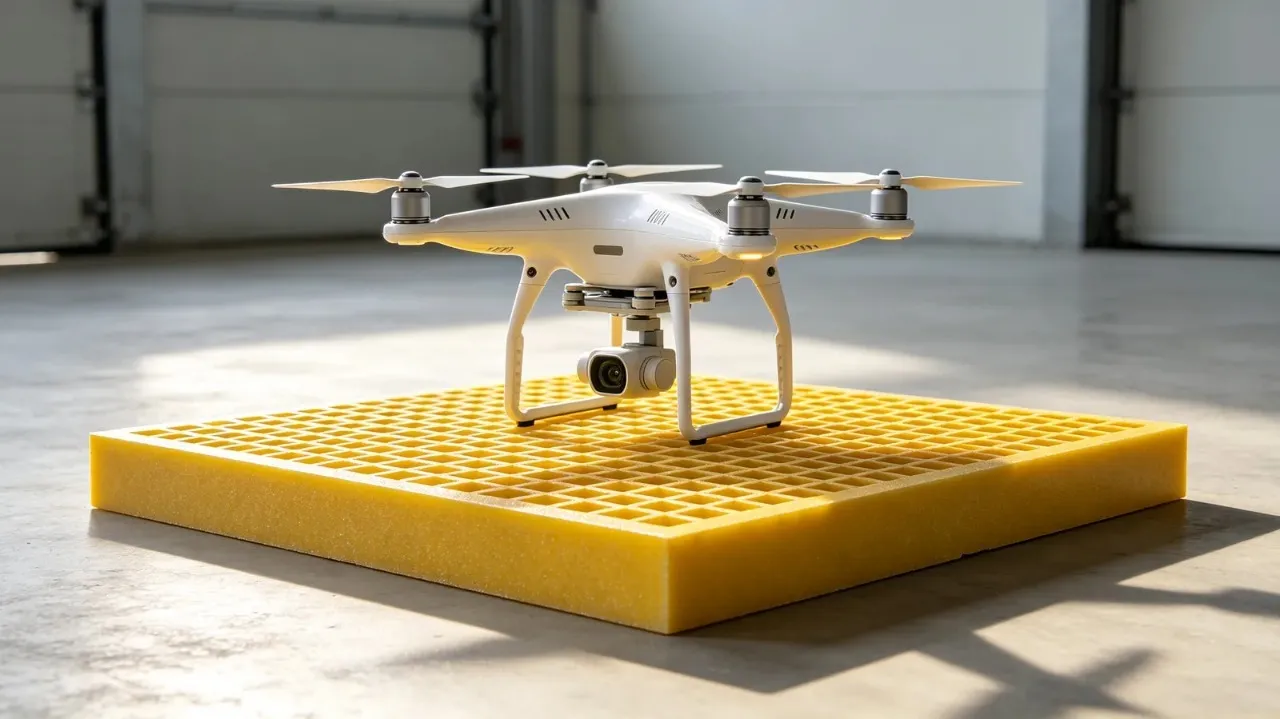
Drone Landing Platform
- Location:
- Northeast Asia
- Year:
- 2023
- Category:
- Infrastructure
Roof and industrial drone operations are now mainstream in inspection, surveying, security, and logistics. A landing pad that survives repeated UAV cycles, weather extremes, and the occasional hard landing is the infrastructure piece most facilities overlook. FRP grating pads fill that role well — they are flat, stable, drainable, and replaceable as a panel rather than as a slab.
What a drone landing pad actually needs
UAV platforms look simple but have a specific set of requirements that differ from a pedestrian walkway or even a vehicle apron.
- Flatness under repeated load. A consumer drone weighs under 2 kg; an industrial inspection drone lands at 5–25 kg with hard impact spikes at touchdown. The panel cannot deflect more than a few millimetres under either.
- Surface friction across conditions. Wet, dusty, oily, or frosted — the pad has to hold friction for both the drone's landing gear and any human operator nearby. R11 / R12 / R13 ratings per DIN 51130 cover the typical use cases.
- Drainage and debris shedding. Standing water fouls downward sensors and rotor dynamics. Open-grid construction drains fast.
- Lightning protection. Drones carry electronics, and pad locations are typically elevated and exposed. A non-conductive pad prevents ground-fault hazards while still allowing proper bonding for lightning current paths.
- Outdoor durability. UV, frost-thaw, summer heat, salt spray in coastal sites. Resin selection and surface veil matter more than panel thickness.
Why FRP grating fits
Weight. A 1.5 m × 1.5 m moulded FRP panel at 38 mm thickness weighs around 12 kg/m². Comparable concrete pavers run 110 kg/m². On a rooftop, where every additional kilogram multiplies into structural steel cost, FRP is the only rational choice for a pad of any real size.
Dimensional stability. Properly formulated isophthalic or vinyl ester resin systems hold flatness across -30 °C to +60 °C, with thermal expansion coefficients close to those of steel. The panel does not bow, cup, or oil-can over seasonal cycles.
Custom sizing. Drone pads range from 1.2 m × 1.2 m for consumer UAVs to 6 m × 6 m or larger for industrial drone classes. Modular FRP panels cut to size on site accommodate any geometry without bespoke fabrication lead time.
Surface options. Fine quartz-grit for the operator walking surface (typically the perimeter ring), with optional smooth or concave in the centre where the drone actually touches down. The grit texture does not interfere with propeller downwash or downward sensors.
Replaceability. When a panel is damaged — by a hard landing, dropped equipment, or fatigue — it lifts out and a new one drops in. No demolition, no curing time, no specialised crew.
Resin and construction specification
For outdoor rooftop or industrial sites:
- Isophthalic polyester with a UV-inhibited surface veil — the default for most climates.
- Vinyl ester for coastal sites, chemical exposure, or where the pad also sees washdown.
- Phenolic for fire-smoke-sensitive locations — over occupied space, near fuel storage, or inside covered structures.
- 38 mm moulded with 19 mm or 25 mm mesh — the typical drone pad spec. Pultruded panels also work for larger spans or higher point loads.
Standard Endura FRP panel sizes (1220 × 3660 mm, 1220 × 4040 mm, 915 × 3050 mm) cut to the pad footprint with banded edges. Stainless-steel M-clip or saddle-clip fixings.
Installation on rooftops and existing structures
Most retrofit drone pad installations bolt to an existing steel or concrete curb. The FRP panels do not require a continuous subfloor — stringers at 600 mm centres are sufficient for pedestrian and light equipment loads. New construction can integrate the pad into the rooftop framing plan from the start.
Common installation patterns:
- Curb-mounted. FRP panels sit on a 50–100 mm raised curb with edge banding. Water drains off the edge to the existing rooftop drainage.
- Recessed. Panels drop into a recessed frame flush with the surrounding deck. Best for high-traffic roofs where the pad should not be a trip hazard.
- Freestanding on legs. Used for greenfield installations where the pad is elevated above equipment or terrain.
All three patterns work. Recessed is most common on occupied rooftops; curb-mounted is the standard for industrial and utility sites.
Marking and visual aids
Drone pads typically carry a painted or taped centre marker and perimeter ring. The grit surface of FRP accepts epoxy-based marking paint well; for permanent markings, in-mould colour is available. Edge lighting (low-voltage LED perimeter strips) integrates cleanly into the banded edge of the panel.
Field performance
Endura FRP drone pad installations have been in service since 2020 across rooftop, tower, and industrial sites in East Asia, Southeast Asia, and the Middle East. None have required panel replacement due to material failure. The most common service call is surface re-marking after a few years of foot traffic.