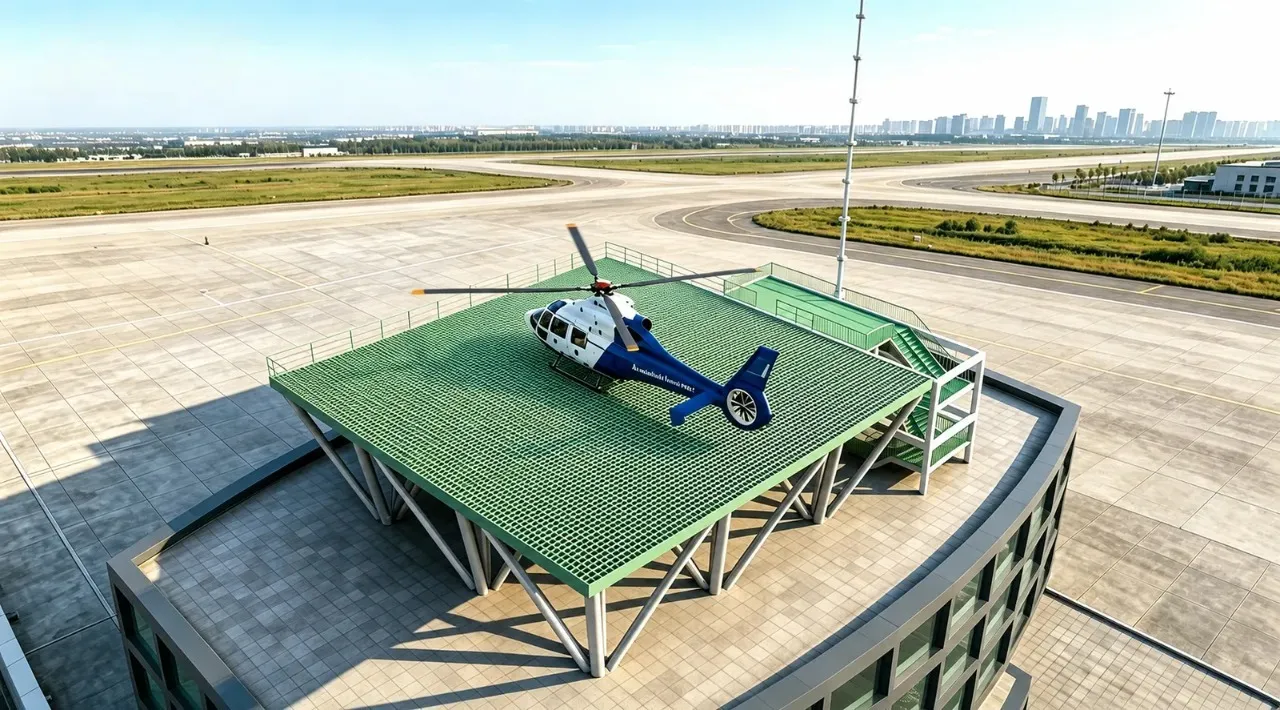
Helipad Platform
- Location:
- Southeast Asia
- Year:
- 2024
- Category:
- Offshore
Rooftop and offshore helipads have to meet a tighter set of constraints than almost any other walking or landing surface in commercial use. They take the load of a fully-fuelled helicopter on a small landing-gear footprint, drain fuel and water without slip risk, hold non-sparking certification when over fuel-handling areas, and survive salt spray or industrial atmosphere for decades without recoating. Steel and aluminium both struggle with one or more of these. FRP grating covers all of them — which is why almost every new-build helideck on offshore platforms and most new hospital rooftop helipads in Asia now specify FRP as the default.
Helipad design requirements
A modern helipad is governed by regulatory standards that depend on where it sits:
- ICAO Annex 14, Volume II — international standard for heliports, including rooftop and shipboard installations.
- FAA AC 150/5390-2C — U.S. heliport design standard.
- IMO MSC.1/Circ.1328 — guidelines for helicopter facility operations on ships, including offshore helidecks.
- CAP 437 (UK CAA) — offshore helideck standard, widely referenced globally.
Key load and surface requirements across these standards:
- Touchdown load of 6–8 tonnes for medium helicopters (AW139, S-92, H175), concentrated on a small footprint during landing.
- Surface friction coefficient ≥ 0.65 wet, ≥ 0.85 dry, per ICAO / FAA friction testing.
- Perimeter safety net at the platform edge (typically 1.5 m wide).
- Drainage that handles fuel and water without ponding.
- Non-sparking when located above fuel storage or handling.
- Conductive top layer for lightning protection, bonded to the airframe discharge path.
These constraints disqualify several common flooring systems. Concrete is heavy and cracks. Steel grating sparks on impact. Aluminium is conductive. Plain FRP without a conductive top layer does not dissipate lightning.
Why FRP is the standard spec
Weight savings. A typical 18 m × 18 m helipad on FRP grating weighs 60–70% less than the equivalent concrete deck. On a building rooftop, that delta translates directly to lower structural steel tonnage and a smaller foundation. On an offshore platform, it is often the difference between a feasible retrofit and an unfeasible one.
Corrosion resistance. Salt spray, jet fuel vapour, hydraulic fluid, de-icing fluid — the deck sees it all. Vinyl ester FRP panels rated for jet fuel exposure (per ASTM C581 testing) hold service life over 25 years with zero recoating.
Slip resistance. Quartz-grit top surfaces meet ICAO wet-friction thresholds with margin to spare, even after years of jet fuel and rubber deposits.
Non-sparking. Properly formulated FRP with no exposed metallic aggregate is spark-free on impact. Required for helidecks above fuel handling or co-located with hydrocarbon processing.
Lightning dissipation. Conductive FRP formulations (carbon-filled resin or surface veil) provide a path for lightning current to ground without damaging the panel. Bonding to the platform lightning system is straightforward.
Modular construction. FRP panels ship cut-to-size and banded. An 18 m × 18 m helipad is typically 60–80 panels, installed in 3–5 days with a small crew. No on-site welding, no hot-work permit, no curing time.
Panel specification for helipads
The standard Endura FRP helipad spec:
- Resin: vinyl ester (ASTM C581 tested in jet fuel, hydraulic fluid, salt spray)
- Construction: 50 mm moulded for the touchdown zone, 38 mm moulded for the perimeter and walkway
- Mesh: 19 × 19 mm standard (12 × 12 mm if small-tool drop is a concern)
- Surface: integral quartz grit, fine grade (20–40 mesh), conductive variant where lightning dissipation is specified
- Edges: banded on all exposed edges
- Fixings: stainless-steel M-clip or saddle clip, M10 or M12 grade
- Conductive layer: 10⁶–10⁹ Ω/sq surface resistivity where required
- Marking: ICAO-compliant H marking and circle, painted with epoxy paint or in-mould colour
A complete helipad submittal package includes the resin certificate, ASTM E84 Class 1 fire rating, friction test data, and load calculations for the design helicopter class.
Installation contexts
Rooftop helipads (hospital, commercial, residential) — the weight savings matter most. The deck is typically installed on a steel curb frame, with the existing rooftop structure receiving only modest reinforcement. Installation can usually happen without shutting down the building below.
Offshore helidecks — weight and corrosion matter most. Most offshore helidecks today are FRP retrofit over an existing steel substructure, replacing the original grating that has reached end of service life. The retrofit window is typically 2–3 days.
Ground-level hospital helipads — drainage and marking matter most. FRP is the right answer here too, but the weight advantage is less critical.
Field performance
Endura FRP helipad installations in service since 2018 across Southeast Asia and the Middle East show no panel failures and no surface degradation beyond cosmetic wear in the touchdown zone. Friction coefficients remain in spec six or more years after installation. The most common service activity is repainting of the markings on a 4–5 year cycle.