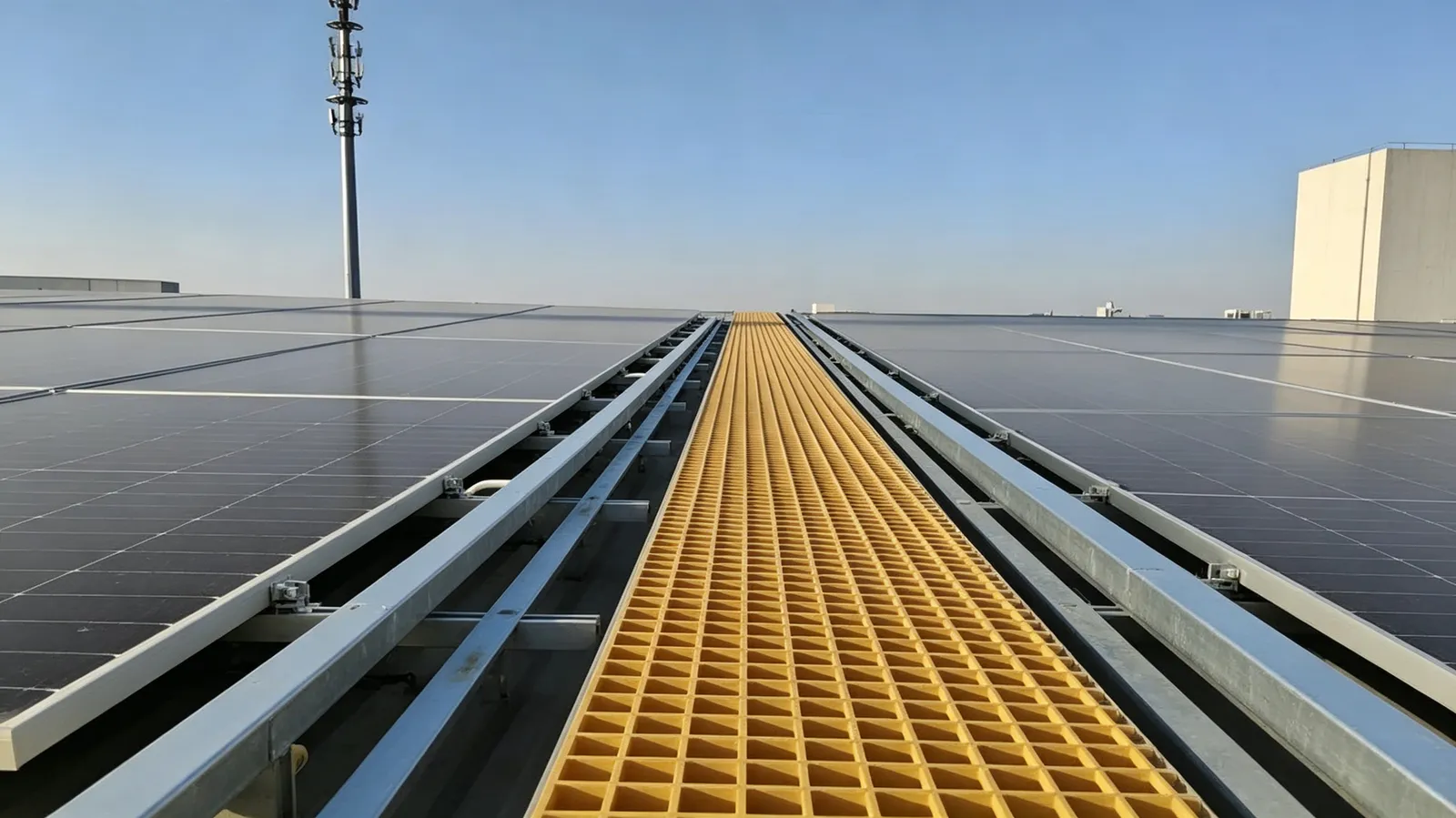
PV Walkway Board
- Location:
- Global
- Year:
- 2025
- Category:
- Solar Energy
In the global wave of clean-energy expansion, the photovoltaic industry is scaling at a remarkable pace. As PV power plants grow larger and more distributed, the infrastructure around them — walkways, cable covers, equipment platforms — must keep up. FRP (Fiber Reinforced Plastic) grating has become the standard material for this infrastructure.
1. Characteristics of FRP Grating Walkway
FRP grating weighs one-quarter to one-third the mass of an equivalent steel panel. It resists corrosion from humidity, salt spray, and the acidic conditions that can develop under bird-deterrent or anti-soiling coatings. Electrically non-conductive — a critical safety property near live DC strings. Anti-slip gritted surface performs in rain, frost, and dust. Modular panels cut and drill on-site with standard tools.
2. Application Scenarios in the Photovoltaic Field
(1) Photovoltaic Module Maintenance Channels
Laid between rows of PV modules to give O&M crews safe footing for cleaning, inspection, and replacement work. Panel length can be tuned to module pitch.
(2) Cable Tray Covers
Protects DC string cables, combiner-box conduits, and communication lines. Non-conductive material prevents ground-fault risks if cable insulation is damaged.
(3) Equipment Platforms
For inverters, transformers, and switchgear at the edge of array blocks. Withstands weather extremes — UV, monsoon rain, dust — without corrosion.
3. Application Advantages
(1) Reducing the Total Life-Cycle Cost
20–30 year service life with no repainting and no rust-through. Replaces the typical 7–10 year steel walkway replacement cycle.
(2) Improving Installation Efficiency
Modular panels arrive cut-to-length. Two workers can complete most walkway runs without lifting equipment.
(3) Environmental Protection and Energy Conservation
Fully recyclable at end of life. Manufacturing energy is roughly one-third that of steel grating.
4. Development Trends and Future Prospects
Embedded fiber-optic and strain-gauge sensors are entering trials — enabling structural-health monitoring and predictive maintenance directly through the grating layer. Costs continue to fall as photovoltaic deployment scales.